Translate

Saturday, January 9, 2016

140 protesters killed by Ethiopia security forces


140 protesters killed by Ethiopia security forces


[JURIST] Ethiopian government security forces have killed 140 protesters [text] in the Oromia region despite December reports of only five deaths, Human Rights Watch (HRW) [advocacy website] said Thursday. The protesters began demonstrations in November against the government's plan to expand the country's capitol, Addis Ababa, onto farmland and property occupied by approximately 2 million Oromia people. HRW also claims that the government has been arbitrarily arresting politicians, like Bekele Gerba [Reuters report], and ordinary citizens who support the movement. The group also raised concerns over how excessive force and arrests impact the "long-term stability" of the country. HRW called for the release of those detained and that the government take responsibility for its use of force and allow for peaceful protests.
In December HRW reported that activists had witnessed security forces firing into throngs of protesters [HRW report]. That report came a day after Ethiopia's Prime Minister, Hailemariam Desalegn [BBC profile], warned[IBT report] of "merciless legitimate action against any force bent on destabilising the area." Ethiopian officials have been claiming that the demonstrations are a front for those involved in the protests to insight violence and threaten the stability of the nation. The government labeled the primarily peaceful activists as "terrorists" as a means to justify the call for force. Ethiopia has used its broad anti-terrorism laws to detain political opposition before. In October five Ethiopian bloggers were acquitted of terrorism charges relating to publications on their website [Zone9, in Amharic]. The publications, critical of the government, landed nine bloggers in jail [JURIST report], and one charged in absentia, in April 2014, for violation of the laws. That same month UN Special Rapporteur on counter-terrorism and human rights Ben Emmerson [official profile] expressed concern [press release] over the rising use of counter-terrorism measures around the world[JURIST report]. Many nations have used counter-terrorism as an excuse to restrict public assembly and stop the activities of public interest groups, Emmerson said.

Monday, January 4, 2016

Ethiopia university grenade attack

Sunday, December 27, 2015

Ethiopian opposition figures arrested over land protests

NewsWires : euronews : the latest international news as video on demand: "Ethiopian opposition figures arrested over land protests
REUTERS, 25/12 17:47 CET

smaller_textlarger_text
By Aaron Maasho

ADDIS ABABA (Reuters) – Ethiopian police have arrested two senior opposition members on suspicion of inciting weeks of protests against government plans to set up a new economic zone near the capital that would displace farmers, their party leader said on Friday.

The Oromo Federalist Congress (OFC) says 87 protesters have been killed by police since demonstrations broke out this month in Oromiya region, in the country’s worst civil unrest for a decade.

On Dec. 15, a government spokesman said police had a list of five people who had died during the protests, but casualties could be higher. Officials have yet to announce an updated number.

OFC chairman Merara Gudina said police rounded up his deputy Bekele Gerba and the party’s assistant secretary Dejene Tafa on Thursday, and both remained in custody.

“They suspect that our party and some of our members are part of the protest movement, that we have been inciting the demonstrations,” he told Reuters, denying that the OFC had incited violence. “We do not know when Bekele and Dejene will be released or be charged for anything.”

Government officials were not immediately available for comment, but Prime Minister Hailemariam Desalegn told parliament on Friday that “anti-peace forces” had incited violence by spreading false information about the so-called “Addis Ababa Integrated Development Master Plan” to create an investment and industrial zone near the capital.

He said members of “terrorist groups” had infiltrated protesters and that the government would take “unflinching measures” against them.

Addis Ababa has accused the secessionist Oromo Liberation Front (OLF) and opposition group Ginbot 7 of involvement in the protests. It labels both groups as terrorist organisations.

Oromiya is Ethiopia’s largest region by size and population. Dissident groups such as the OLF, which is waging a low-key rebellion, accuse the ruling EPRDF coalition of marginalising ethnic Oromos.

The second most populous nation in Africa with 90 million people, Ethiopia has long been one of the poorest countries in the world per capita, but has made startling strides towards industrialisation, recording some of the continent’s strongest economic growth rates for a decade.

But reallocating land for new uses is a thorny issue in a country where the vast majority of the population still survives on smallholder farm plots. The opposition says farmers have often been forced off land and poorly compensated.

(Reporting by Aaron Maasho; editing by Edith Honan and Mark Trevelyan)"


'via Blog this'

Thursday, December 24, 2015

Blood and terror in Ethiopia as protests sweep the streets - Yahoo News


AFP 


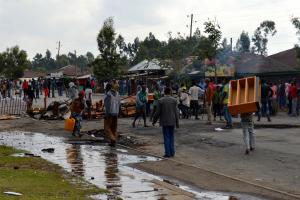
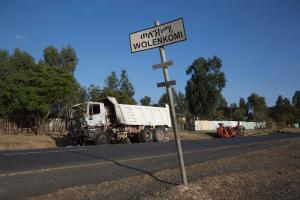
People in Wolenkomi, some 60km west of Ethiopia's capital Addis Ababa stand on December 15, 2015 near the body of a protester from Ethiopia's Oromo group allegedly shot dead by security forces
.

View gallery


  • .
  • .
  • .
Wolenkomi (Ethiopia) (AFP) - Two lifeless bodies lay on the ground as the terrified crowd, armed only with sticks against gun-toting Ethiopian security forces, fled the fierce crackdown on protesters.
Blood seeped through a sheet covering one of the bodies on the road outside Wolenkomi, a town just 60 kilometres (37 miles) from the capital Addis Ababa.
"That was my only son," a woman sobbed. "They have killed me."
Back at the family home of 20-year-old Kumsa Tafa, his younger sister Ababetch shook as she spoke. "He was a student. No one was violent. I do not understand why he is dead," she said.
Human Rights Watch says at least 75 people have been killed in a bloody crackdown on protests by the Oromo people, Ethiopia's largest ethnic group.
Bekele Gerba, deputy president of the Oromo Federal Congress, puts the toll at more than 80 while the government says only five have been killed.
The demonstrations have spread to several towns since November, when students spoke out against plans to expand the capital into Oromia territory -- a move the Oromo consider a land grab.
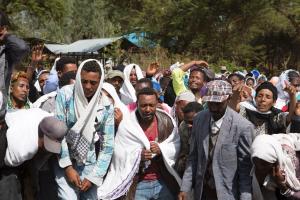
The sight of the protesters on the streets of towns like Wolenkomi -- shouting "Stop the killings! This isn't democracy!" -- is rare in a country with little tolerance for expressions of discontent with the government.
Tree trunks and stones are strewn on the asphalt on the road west from Addis to Shewa zone, in Oromia territory, barricading the route for several kilometres.
Chaos broke out on a bus on the road when it emerged that the police were again clashing with demonstrators in Wolenkomi.
"My husband just called me," said a woman clutching her phone, as others screamed and children burst into tears.
"He's taking refuge in a church. Police shot at the protesters," she said.
The man next to her cried in despair: "They're taking our land, killing our children. Why don't they just kill everyone now?"
The army raided Wolenkomi again the next day, the rattle of gunfire lasting for more than an hour.
"They grabbed me by the face and they told me, 'Go home! If you come back here, we'll kill you'," said Kafani, a shopkeeper.
Rights groups have repeatedly criticised Ethiopia's use of anti-terrorism legislation to stifle peaceful dissent, with the US expressing concern over the recent crackdown and urging the government to employ restraint.
But Prime Minister Hailemariam Desalegn declared on television that the government would act "without mercy in the fight against forces which are trying to destabilise the region."
- 'Land is everything' -
Oromo leaders have vowed to keep up their resistance against proposals to extend Addis, and Human Rights Watch has warned of "a rapidly rising risk of greater bloodshed".
"The government can continue to send security forces and act with violence -- we will never give up," said Gerba.
Land is at the heart of the problem. Under Ethiopia's constitution, all land belongs to the state, with owners legally considered tenants -- raising fears amongst the Oromo that a wave of dispossession is on its way.
"For farmers in Oromia and elsewhere in the country, their land is everything," said Felix Horne, a researcher at Human Rights Watch.
"It's critical for their food supply, for their identity, for their culture," he said.
"You cannot displace someone from their land with no consultation and then inadequately compensate them and not expect there to be any response," Horne warned.
Some Oromo have already seen their lands confiscated.
Further west, in the town of Ambo, a woman named Turu was expropriated of her two hectares, receiving only 40,000 birr ($1,900, 1,700 euros) in compensation.
"We had a good life before," she said.
Today she struggles to support her four children and her disabled husband with the 30 birr a day ($1.40, 1.30 euros) she earns working in a factory.
With their own language distinct from Ethiopia's official Amharic tongue, the 27 million Oromo make up nearly 30 percent of the country's population.
"The Oromos are seen as more of a threat by the government in part because they are by far the largest ethnic group," said Horne.
The proposed expansion of Addis is part of a 25-year development plan to boost the city's infrastructure and attract new investors.
It sparked demonstrations last year, but on a smaller scale.

Ethiopia Opposition: 80 Killed in Protests Against Land Plan - The New York Times

ADDIS ABABA, Ethiopia — Ethiopian government forces have killed more than 80 people in the past four weeks in protests in the country's Oromia region, an Ethiopian opposition party charged Wednesday.
The killings should be investigated, said the Ethiopian Federal Democratic Unity Forum, a coalition of four opposition parties, at a press conference.
"Trigger-happy government forces have killed more than 80 peaceful protesters in Ethiopia during the past four weeks," Beyene Petros, president of the party told reporters, adding that hundreds of others were wounded and arrested. "We are still discovering disfigured bodies in various locations. The government has continued its brutal killings so we call on the international community and donors to step in and force the government to stop these inhumane actions."
Party officials provided names of the alleged victims to The Associated Press.
The government has rejected, for the second time, the opposition party's request to hold a public demonstration on Dec. 27 to protest the controversial Addis Ababa Master Plan, the opposition leader said.
The opposition party's charge comes after a report last week by Human Rights Watch that said government forces killed at least 75 people protesting the government plan to incorporate some rural areas into the capital city, Addis Ababa.
Violent clashes between protesters and security forces have spread across Ethiopia's Oromia Region, the biggest and most populous of Ethiopia's federal states. Oromo students have led protests against the government's plan which they charge will take lands from their region and displace thousands of farmers.
The government charges that the protesters are working with "terrorists." It claims that only five protesters have been killed and that the development plan for Addis Ababa will not deprive farmers of land. Prime Minister Hailemariam Desalegn warned that the government "will take merciless legitimate action against any force bent on destabilizing the area," speaking on Ethiopian state television.
But the protests have continued.
"This is the biggest demonstration in the region's history. The immediate cause is the so-called Addis Ababa Master Plan that will rob Oromo farmers of their land and rights, the main reason is that people are fed up with cadres and politicians of the ruling party," said Merara Gudina, a prominent Oromo opposition figure, told the Associated Press.
Many of the areas of Oromia are now under military control, said Gudina, vice-chairman of the Ethiopian Federal Democratic Unity Forum.
Amnesty International urged officials not to use draconian anti-terrorism measures to quell protests.
"The suggestion that these Oromo — protesting against a real threat to their livelihoods — are aligned to terrorists will have a chilling effect on freedom of expression for rights activists," Muthoni Wanyeki, Amnesty International's Regional Director for East Africa said.
The U.S. State Department has expressed concern over the clashes. "The United States is deeply concerned by the recent clashes in the Oromia region of Ethiopia that reportedly have resulted in the deaths of numerous protesters," said spokesman Mark Toner in a statement. "We urge the government of Ethiopia to permit peaceful protest and commit to a constructive dialogue to address legitimate grievances. We also urge those protesting to refrain from violence and to be open to dialogue."
The situation in and around the Woliso University campus seems calm but all the entrances to the Woliso town are guarded by soldiers, Seyoum Teshome, a professor at school, which was one of the protest sites, told the Associated Press by phone: "The situation seems calm at the moment but you could feel the tense atmosphere."