Translate

Sunday, March 10, 2019

Ethiopian Airlines Boeing 737 crash near Addis Ababa no survivor!


157  people on board an Ethiopian Airlines flight that crashed soon after taking off from Addis Ababa have been killed, the airline said on Sunday morning.
The plane, en route to Nairobi, Kenya, lost contact at 8:44 a.m. local time, six minutes after taking off from Bole International Airport in the Ethiopian capital.
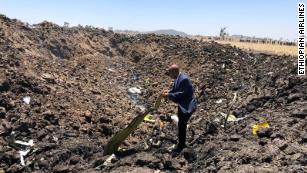
The aircraft, flight number ET302, went down near Bishoftu, southeast of Addis Ababa. An airline spokesperson told CNN the victims were of 35 different nationalities.
The spokesperson said 32 Kenyans, 18 Canadians, nine Ethiopians, eight Americans, eight Italians and seven UK nationals were among the passengers.
Eight Chinese passengers were also on board, said Li Liang, spokesperson for the Chinese Embassy to Ethiopia.
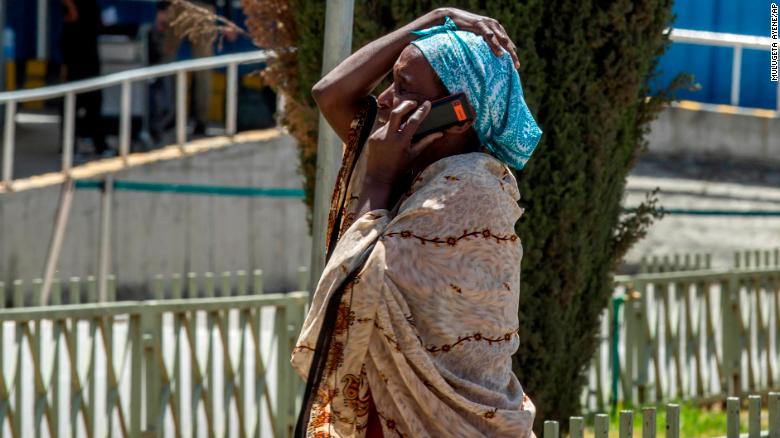
A family member of a victim of the crash awaits news at Addis Ababa airport.
Ethiopian Airlines CEO, Tewolde GebreMariam, told reporters at a press conference that the pilot had reported technical difficulties and asked for clearance to return to Addis Ababa.
He was given clearance to turn back, according to GebreMariam, citing the Air Traffic Controllers record.

The pilot was a senior Ethiopian Airlines pilot who had flown more than 8,000 hours. He had an "excellent flying record," according to the CEO.
The CEO visited the crash site on Sunday. He said the plane "is now right inside the ground" and it was not possible to identify whether it was an emergency landing or a crash. He said there was still smoke at the site when he visited.
"As it is a fresh incident, we have not been able to determine the cause. As I said, it is a brand new airplane with no technical remarks, flown by a senior pilot and there is no cause that we can attribute at this time."
"The routine maintenance check didn't reveal any problems," GebreMariam added.
Asked about the possibility of terrorism or sabotage: "At this stage we cannot rule out anything."
The Boeing 737 MAX 8 is the same type of plane as the Indonesian Lion Air jet that crashed soon after takeoff from Jakarta in 2018 -- killing 189 people.
"They of course are the same [model of 737 MAX 8] planes," but GebreMariam said only an investigation could make any conclusions.
The airline said in an earlier statement that staff would "be sent to the accident scene and will do everything possible to assist the emergency services."
Nairobi
Addis Ababa

Map data ©2019 Google, SK telecom Imagery ©2019 TerraMetrics


It added that a passenger information center and hotline "will be available shortly for family or friends of those who may have been on flight."

Monday, February 11, 2019

Kidame Gebeya fire Gonder

አስፈላጊ ከሆነ ወደ ጦርነት እንገባለን - ጌታቸው ረዳ | Ethiopia

Monday, January 14, 2019

OLF held region bombarded by Ethiopia army AN


Ethiopia army executing airstrikes against OLF in western Oromia

ETHIOPIA

The Ethiopian army on Sunday morning (January 13) started an aerial operation targeting areas in western Oromia believed to be he held by ex-rebel group, Oromo Liberation Front, OLF.
The Addis Standard portal cited an unnamed military source as confirming the air strikes in Qellem Wellega and surrounding areas.
The portal quoted the source as saying the strikes were targeted at “military camps run by the OLA,” in reference to the Oromo Liberation Army, the armed wing of the OLF. It is not known when the strikes are supposed to end.
The action is tied to two bank robbery incidents that were reportedly carried out by armed members of the OLF. The Commercial Bank of Ethiopia and the Cooperative Bank of Oromia were robbed on Saturday. Local media outlets are reporting that hostages were taken in the robbery.
The regional administration also told the VOA Amharic service that bank robbery cases in western Oromia had shot up at the last count that 10 incidents had been reported.
The OLF is one of about a half-dozen rebel groups that were based in next-door Eritrea. Its leadership agreed to return home to pursue peaceful political struggle after the Ethiopia – Eritrea peace deal of July 2018.
OLF fighters crossed the border back home after years in Eritrea before its leadership led by Dawud Ibsa flew into the capital Addis Ababa to much fanfare and jubilation.
The group has since their return gotten into disagreement with the federal government especially on the deployment of troops in areas it says its fighters are ‘active.’
Many political and security watchers have warned that basic disagreement between OLF and the regional and federal government led by Prime Minister Abiy Ahmed could prove fatal for ongoing reforms.

Friday, January 4, 2019

Trouble With Ethiopia’s Ethnic Federalism - New York Times

The reforms by the country’s new prime minister are clashing with its flawed Constitution and could push the country toward an interethnic conflict.


By Mahmood Mamdani
Mr. Mamdani is the director of the Institute of Social Research at Makerere University in Kampala, Uganda, and a professor at Columbia University.
  • Abiy Ahmed, the 42-year-old prime minister of Ethiopia, has dazzled Africa with a volley of political reforms since his appointment in April. Mr. Abiy ended the 20-year border war with Eritrea, released political prisoners, removed bans on dissident groups and allowed their members to return from exile, declared press freedom and granted diverse political groups the freedom to mobilize and organize.

Mr. Abiy has been celebrated as a reformer, but his transformative politics has come up against ethnic federalism enshrined in Ethiopia’s Constitution. The resulting clash threatens to exacerbate competitive ethnic politics further and push the country toward an interethnic conflict.
The 1994 Constitution, introduced by Prime Minister Meles Zenawi and the Ethiopian People’s Revolutionary Democratic Front governing coalition, recast the country from a centrally unified republic to a federation of nine regional ethnic states and two federally administered city-states. It bases key rights — to land, government jobs, representation in local and federal bodies — not on Ethiopian citizenship but on being considered ethnically indigenous in constituent ethnic states.
Ethnic mobilization comes from multiple groups, including Ethiopians without an ethnic homeland, and those disenfranchised as minorities in the region of their residence, even if their ethnic group has a homeland in another state.
Ethnic federalism also unleashed a struggle for supremacy among the Big Three: the Tigray, the Amhara and the Oromo. Although the ruling E.P.R.D.F. is a coalition of four parties, the Tigray People’s Liberation Front representing the Tigray minority has been in the driving seat since the 1991 revolution. The Amhara, dominant before 1991, and the Oromo, the largest ethnic group in the country, complained they were being treated as subordinate minorities.
When the government announced plans to expand Addis Ababa, the federally run city-state, into bordering Oromo lands, protests erupted in 2015. The Amhara joined and both groups continued to demand land reform, equal political representation and an end to rights abuses.

Prime Minister Haile Mariam Desalegn, who took office in 2012 after the death of the long-term premier and Tigray leader Mr. Zenawi, responded brutally to the protests. Security forces killed between 500 and 1,000 protesters in a year. Faced with a spiraling crisis, the ruling E.P.R.D.F. coalition appointed Mr. Abiy, a former military official and a leader of the Oromo People’s Democratic Organization — a constituent of the ruling coalition — as prime minister.
Mr. Abiy’s reforms have been applauded but have also led to greater ethnic mobilization for justice and equality. The E.P.R.D.F.’s achievement since 1991 was equal education for girls and boys, rural and urban, leading to greater prominence of women, Muslims and Pentecostal groups.
The recent reforms of Mr. Abiy, who was born to a Muslim Oromo father and an Orthodox Amhara mother and is a devout Pentecostal Christian, have further broadened political participation to underprivileged groups.
Mobilization of ethnic militias is on the rise. Paramilitaries or ethnic militias known as special police, initially established as counterinsurgency units, are increasingly involved in ethnic conflicts, mainly between neighboring ethnic states. A good example is the role of the Somali Special Force in the border conflict with the Oromia state, according to Yonas Ashine, a historian at Addis Ababa University. These forces are also drawn into conflicts between native and nonnative groups.
Nearly a million Ethiopians have been displaced from their homes by escalating ethnic violence since Mr. Abiy’s appointment, according to Addisu Gebregziabher, who heads the Ethiopian Human Rights Commission.
Fears of Ethiopia suffering Africa’s next interethnic conflict are growing. Prime Minister Abiy himself is constantly invoking religious symbols, especially those linked to American Protestant evangelical megachurches, and has brought a greater number of Pentecostals into the higher ranks of government.
Ethiopians used to think of themselves as Africans of a special kind, who were not colonized, but the country today resembles a quintessential African system, marked by ethnic mobilization for ethnic gains.
In most of Africa, ethnicity was politicized when the British turned the ethnic group into a unit of local administration, which they termed “indirect rule.” Every bit of the colony came to be defined as an ethnic homeland, where an ethnic authority enforced an ethnically defined customary law that conferred privileges on those deemed indigenous at the expense of non-indigenous minorities.
The move was a response to a perennial colonial problem: Racial privilege for whites mobilized those excluded as a racialized nonwhite majority. By creating an additional layer of privilege, this time ethnic, indirect rule fragmented the racially conscious majority into so many ethnic minorities, in every part of the country setting ethnic majorities against ethnic minorities. Wherever this system continued after independence, national belonging gave way to tribal identity as the real meaning of citizenship.
Many thought the Tigray People’s Liberation Front, representing a minority in the dominant coalition, turned to ethnic federalism to dissolve and fragment Ethiopian society into numerous ethnic groups — each a minority — so it could come up with a “national” vision. In a way it replicated the British system.
But led by Mr. Zenawi, the T.P.L.F. was also most likely influenced by Soviet ethno-territorial federalism and the creation of ethnic republics, especially in Central Asia. Ethiopia’s 1994 Constitution evoked the classically Stalinist definition of “nation, nationality and people” and the Soviet solution to “the national question.”
As in the Soviet Union, every piece of land in Ethiopia was inscribed as the ethnic homeland of a particular group, constitutionally dividing the population into a permanent majority alongside permanent minorities with little stake in the system. Mr. Zenawi and his party had both Sovietized and Africanized Ethiopia.
Like much of Africa, Ethiopia is at a crossroads. Neither the centralized republic instituted by the Derg military junta in 1974 nor the ethnic federalism of Mr. Zenawi’s 1994 Constitution points to a way forward.
Mr. Abiy can achieve real progress if Ethiopia embraces a different kind of federation — territorial and not ethnic — where rights in a federal unit are dispensed not on the basis of ethnicity but on residence. Such a federal arrangement will give Ethiopians an even chance of keeping an authoritarian dictatorship at bay.
Mahmood Mamdani is the director of Makerere Institute of Social Research in Uganda, a professor of government at Columbia University and the author of “Citizen and Subject: Contemporary Africa and the Legacy of Late Colonialism.”


Saturday, October 20, 2018

Ethiopia's PM changed his version says "soldiers who marched on palace sought to 'kill me'

Hundreds protesting soldiers, some of them armed, went to see the prime minister odddice  - reportedly to demand a pay rise. The 42-year old leader doing push-ups with smiling men in fatigues and red berets, some of whom stood to snap photos on their mobile phones.


A week after he changed his version and claims:
 
“The approach taken (by the soldiers) was not only unconstitutional and dangerous, but the intent was also to abort reforms,” Abiy address to parliament in which he gave details of the incident after making new version shows how he masters the situation though pushup. 
And added: “Had we not taken a cautious approach, it could have led to a dangerous situation. All this took place without a single bullet being fired and a single loss of life,” he said, adding unspecified forces “regretted missing out on the opportunity to kill” him.
But his actions have failed to curb violence between different ethnic groups against each other. About 2.8 million people out of a population of 100 million have been displaced since he came to power.
In June, a grenade attack attended by tens of thousands of his supporters rattled a rally moments after he finished giving a speech, killing two people. Last month, Ethiopian prosecutors charged five suspects with terrorism over an attempt to kill Mr Abiy in a grenade attack at a rally in June.
In recent months, thousands of people were arrested on suspicion of involvement in violence in the capital and its outskirts that left dozens of people dead.
“Lawlessness is the norm these days. It is something that is testing the government,” Abiy said in parliament. “Unless we collaborate and work hand-in-hand, we may not exist as a country anymore.”
Prof. Muse